CF 2194E: The Turtle Strikes Back
Problem Link
https://codeforces.com/contest/2194/problem/E
Brief summary
You are given an n x m grid with values a[i][j] (at least one value is non-negative). Raphael flips exactly one cell, changing a[i][j] to -a[i][j]. After seeing the flip, Michelangelo picks a path from (1,1) to (n,m) moving only right or down to maximize the sum on the path. Raphael wants to minimize that final maximum sum. Compute the minimum guaranteed pleasure for each test case.
Raphael’s spicy sauce on pizza is preferrable for me.
Graph Structure
a directed grid DAG where each cell has edges to the right and down neighbors; Michelangelo chooses a maximum-sum path after Raphael’s single-cell sign flip (minimax on a grid path).
Limits
- Time limit:
2s - Memory limit:
512MB 1 <= t <= 1e41 <= n, m <= 1e61 <= n*m <= 1e6per test casesum(n*m) <= 1e6across all test cases-1e9 <= a[i][j] <= 1e9
Intuition
My first thought was a specialized shortest-path style method (SPFA / Dijkstra flavor), but this is not a shortest-path problem and there is an adversarial flip before the final path is chosen.
Then I considered layered DP with states like “flip not used / flip used”. That still does not work directly, because the flipped cell can be any one of n*m positions. Tracking exact flip location explodes the state space.
The key is to compress by step index: every path from (1,1) to (n,m) visits exactly one cell on each diagonal d = i + j. So instead of tracking which exact cell was flipped globally, we can reason diagonal-by-diagonal.
Why diagonals work: starting from (1,1), each move is either right (increase j by 1) or down (increase i by 1). In both cases, d = i + j increases by exactly 1 each step. So any valid path hits diagonals d = 0, 1, 2, ..., (n-1)+(m-1) in order, and it contains exactly one cell from each diagonal.
Diagonal Group Illustration
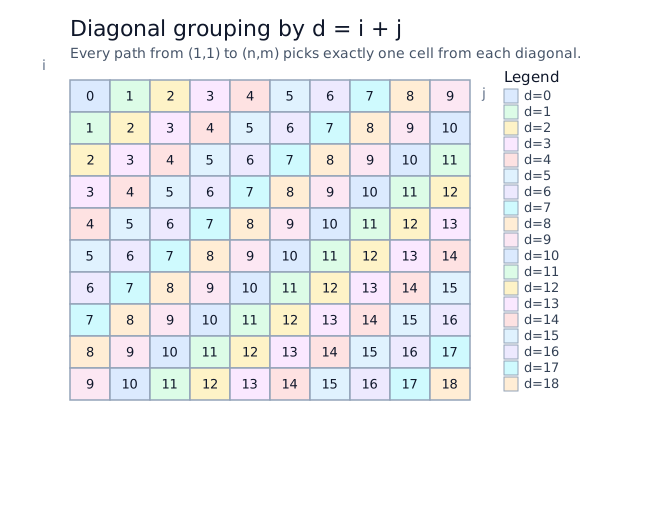
(Generated by scripts/generate_cf2194e_diagonal_illustration.py.)
Solution
- Compute forward DP
f[i][j]: maximum path sum from(1,1)to(i,j). - Compute backward DP
b[i][j]: maximum path sum from(i,j)to(n,m). - Let
opt = f[n-1][m-1]be Michelangelo’s best value without sauce. - For each cell
(i,j), computev = f[i][j] + b[i][j] - a[i][j]. This is the best path value among paths forced to pass through(i,j). - Group cells by diagonal
d = i + j:cnt_opt[d]: how many cells on this diagonal havev == opt.best_alt[d]: maximumvon this diagonal withv < opt.
- If Raphael flips cell
(i,j):- If
(i,j)is not a unique optimal gateway on its diagonal, Michelangelo can still getopt. - Only meaningful trap case:
v == optandcnt_opt[d] == 1. - Then Michelangelo chooses the better of:
- keep that route and pay flip penalty:
opt - 2*a[i][j] - switch to best alternative on same diagonal:
best_alt[d]
- keep that route and pay flip penalty:
- So guaranteed value under this trap is
max(opt - 2*a[i][j], best_alt[d]).
- If
- Raphael minimizes that value over all valid trap cells; answer starts from
optand takes minimum with all trap candidates.
Complexity
- Time:
O(n*m)per test case. - Memory:
O(n*m).
AC Code
/*
Code Notes:
f[i][j] = best sum from (0,0) to (i,j)
b[i][j] = best sum from (i,j) to (n-1,m-1)
opt = f[n-1][m-1] is the best value without sauce
v = f[i][j] + b[i][j] - a[i][j] is the best path value forced through (i,j)
d = i + j groups cells by step index (every path uses exactly one cell per diagonal)
cnt_opt[d] = number of cells on diagonal d with v == opt
best_alt[d] = best value on diagonal d among v < opt
only when (v == opt and cnt_opt[d] == 1) does flipping (i,j) matter:
  outcome = max(opt - 2*a[i][j], best_alt[d])
*/
| |