Geometric Probability: Three Points in a Disk
I recently encountered a few geometric probability problems. They feel quite different from typical probability questions, and I find them intriguing.
Question
Choose three non-collinear points independently and uniformly at random inside a disk. Connect the points pairwise. This partitions the disk into seven regions: one central triangle and three regions bounded by circular arcs.
Let the expected area of the central triangle be $E[A]$, and the expected area of each circular-arc region be $E[B]$. Compute the ratio
$$ \frac{E[A]}{E[B]}. $$Illustration
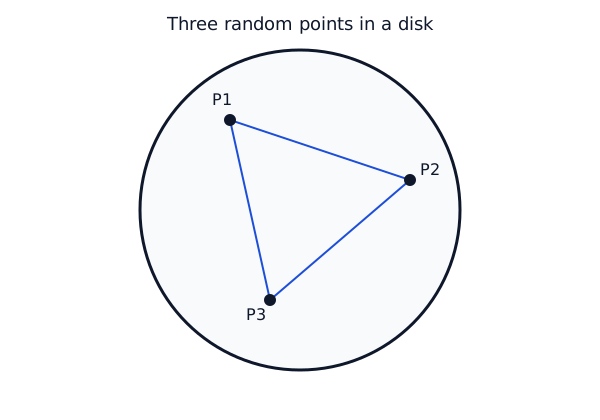
Thinking and intuition
I initially thought this might be similar to another problem about random chords. See the related page:
Solution intuition
Take three random non-collinear points $P_1,P_2,P_3$ in the disk (collinearity has probability $0$). Extend the lines $\overline{P_1P_2}$, $\overline{P_2P_3}$, and $\overline{P_3P_1}$ to infinite lines. In general position, the disk is cut into seven regions: the central triangle $P_1P_2P_3$ and six outer pieces. The three “arc-bounded” regions are the three outer regions adjacent to the three edges of the triangle (not the three vertex-angle regions).
Key trick: introduce a fourth independent uniform point $P_4$ and convert expected areas into probabilities.
Two configurations for four points
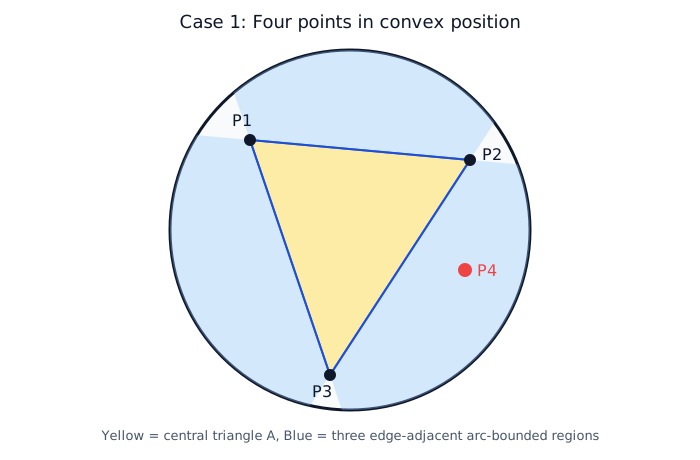
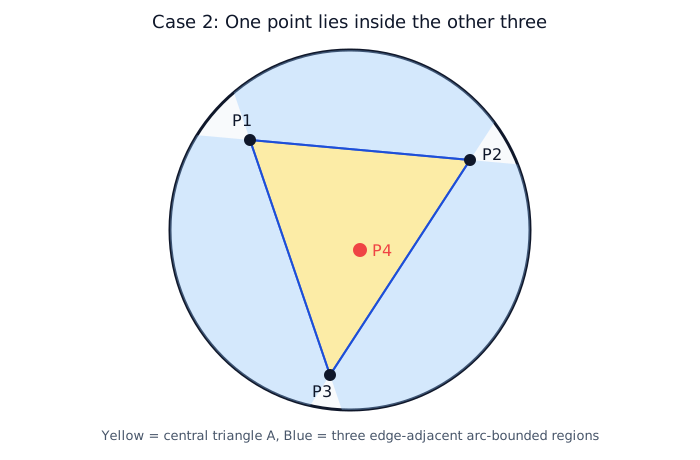
Let $A$ be the triangle area and $B$ the area of one specific arc-bounded region. Then
$$ \frac{E[A]}{\pi}=\Pr(P_4\in \triangle P_1P_2P_3),\qquad \frac{E[B]}{\pi}=\Pr(P_4\in \text{a fixed arc-bounded region}). $$Known results:
$$ E[A]=\frac{35}{48\pi}, $$with a derivation outline here:
Expected triangle area in a disk.
And the Sylvester four-point probability in the unit disk:
$$ q=\Pr(\text{four points are in convex position})=1-\frac{35}{12\pi^2}. $$When four points are in convex position, $P_4$ must lie in one of the three arc-bounded regions, symmetrically, so
$$ \Pr(P_4\in \text{a fixed arc-bounded region})=\frac{q}{3}. $$Therefore,
$$ \frac{E[A]}{E[B]}=\frac{\Pr(P_4\in A)}{\Pr(P_4\in B)} =\frac{p}{q/3}=\frac{3p}{q}, $$where $p=E[A]/\pi=35/(48\pi^2)$. Plugging in:
$$ \frac{E[A]}{E[B]}=\frac{105}{4(12\pi^2-35)}\approx 0.31465. $$